A client once told me they would rather hear a painful “no” than live inside a “maybe.”
It’s easy to read this as pessimism, rigidity, or fear of rejection.
It isn’t.
It’s relief.
And it is a pattern I see frequently in autistic people.
Imagine these three scenarios:
In one situation, a person entered a difficult conversation already fairly certain it would not go well. The other person did, in fact, respond negatively. Yet the conversation was surprisingly manageable.
The conversation was neither kind nor supportive, but it was certainly clear.
Once the words were spoken, their mind stopped searching for alternatives. The emotional processing could finally begin.
The pain was real. The instability was gone.
In another situation, someone asked a peer a direct social question and received an uncertain answer — a non-answer meant to be polite.
They waited. Time passed. The uncertainty became far more distressing than the likely rejection itself. Eventually they asked for a definite yes or no.
They later explained they would have preferred an immediate rejection over the waiting.
Not a preference for harshness. A preference for reality.
In a third context, an organization announced a change and explained it using familiar value-based language: collaboration, effectiveness, shared goals.
The decision itself was inconvenient but manageable. The explanation was what created distress.
When the reasoning was reframed in concrete constraints (obligations, requirements, non-negotiable factors) acceptance became easier, even though the outcome did not change.
Because the explanation could finally be used to predict what would happen next.
Across these situations, the emotional variable isn’t positive versus negative outcome.
It’s whether the situation has resolved into a definite state.
Many people regulate feelings while the future is uncertain. Social norms are built around this: softening bad news, delaying decisions, keeping options open to protect relationships.
But autistic cognition is often organized around building stable predictive models of the world. Ambiguity doesn’t just feel uncomfortable. It prevents the model from resolving.
So some nervous systems don’t treat uncertainty as a feeling. They treat it as unfinished work.
As long as multiple interpretations remain possible, the mind keeps running simulations:
What do they really mean? What is going to happen? What variable am I missing?
What should I prepare for?
The distress comes from the ongoing processing, not the eventual answer.
When the answer arrives, even a painful one, the processing stops.
This is different from the common habit of predicting disappointment to soften it.
People often say “it probably won’t go well” before results arrive -- a test, an interview, an application. If things go badly, they were prepared. If things go well, they feel pleasantly surprised.
That strategy manages feelings while uncertainty continues.
But the people described here are not cushioning uncertainty, they are trying to end it.
They don’t want to brace for impact. They want to know whether impact exists.
Some minds regulate emotion through probability. Many autistic minds regulate through finality.
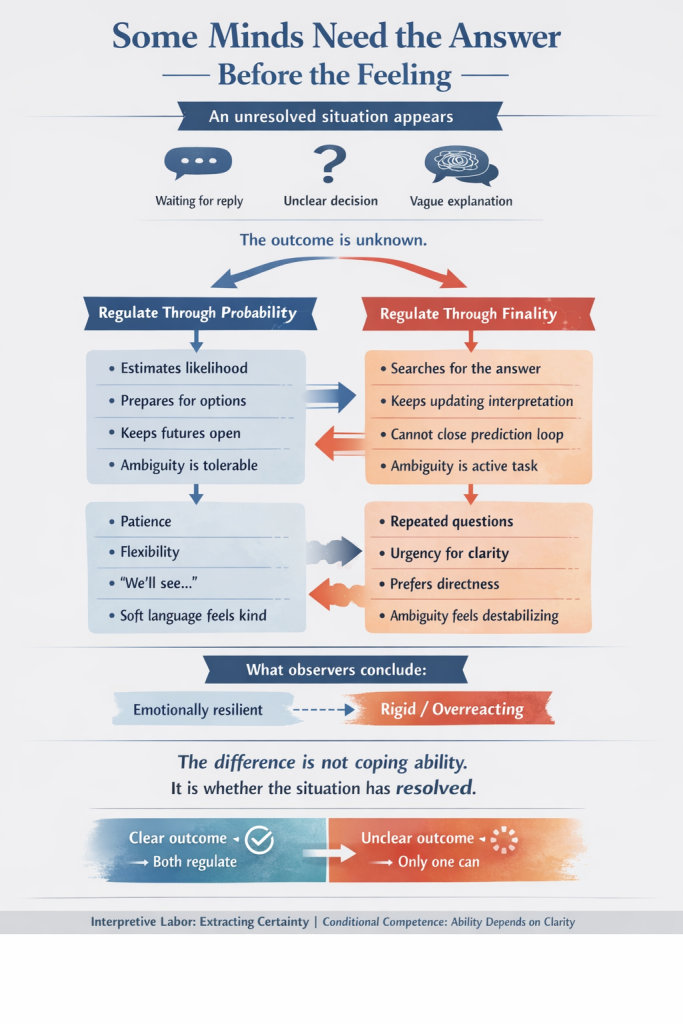
This is where autistic people often become misunderstood.
When the situation is clear, they may appear unusually calm, even in objectively difficult circumstances. They handle bad news, direct feedback, and firm decisions with surprising stability.
When the situation is ambiguous, they may become persistent, urgent, or unable to “let it go.”
From the outside, this looks inconsistent: capable one moment, and overreacting the next.
But the difference is not emotional strength or weakness.
It is whether the environment contains a solvable state.
Remove ambiguity and regulation appears. Remove resolution and the mind keeps working.
This is a form of conditional competence: the same person, the same skills, but functioning changes depending on whether reality is knowable.
What is often interpreted as rigidity is actually an attempt to obtain the information required to stabilize.
Seen this way, the effort to get a clear answer is not stubbornness. It is work.
The person is trying to collapse possibilities into a single reality so their mind can stop running predictions and start responding. When clarity is available, they look calm and capable. When it isn’t, they keep asking, checking, or pressing. This is not to control the situation, but to make it cognitively livable.
This is where interpretive labor appears. They must extract certainty from signals that were never designed to provide it.
And this is where conditional competence forms. Their ability doesn’t disappear; the conditions required to use it do.
Provide a definite state and regulation follows. Withhold it and the mind keeps solving.
So the question often isn’t “Why are they reacting so strongly?” It’s “Has the situation actually become knowable yet?”
They are not asking for bad news. They are asking to know which reality they are in so their mind can stop searching for the others.
Uncertainty is not something to tolerate. It is something the brain cannot stop trying to solve.
And once the problem has an answer, the feeling — whatever it is — finally has somewhere to land.


"*" indicates required fields
"*" indicates required fields

