Autistic adults are often told they’re “bad judges of character.”
Sometimes the language is harsher: naïve, gullible, even character blind.
That framing is wrong.
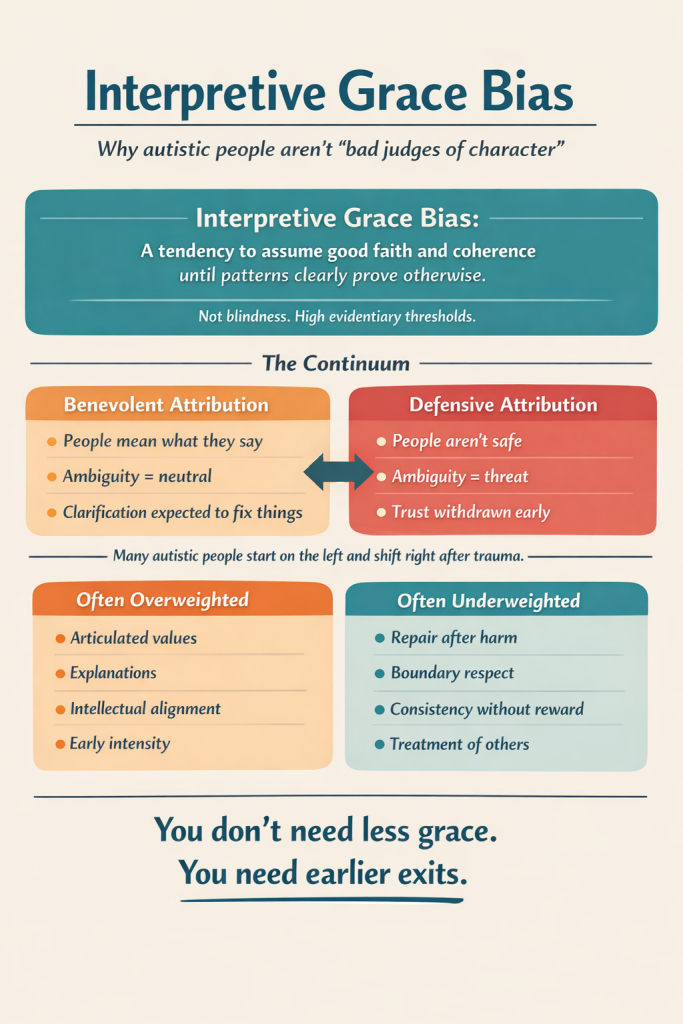
Autistic people do perceive character. What differs is how character signals are interpreted, weighted, and updated over time. What looks like blindness is actually something else entirely: a cognitive pattern I call Interpretive Grace Bias.
Interpretive Grace Bias is the tendency to assume good faith and coherence in others unless the evidence becomes overwhelming.
It shows up as:
The phenomenon is not a manifestation of gullibility. This is ethical restraint applied to people.
Autistic individuals often do notice discomfort early:
The difference is what happens next.
Instead of concluding “this person is unsafe,” the autistic system often asks:
Until the pattern is clear, judgment is suspended.
That delay is frequently misread as poor judgment. I'd argue the delay is more so a high threshold for character reclassification.
There’s an important continuum here.
Many autistic adults start with benevolent attribution—and are pushed toward defensiveness by repeated harm.
When clinicians fail to distinguish autism from trauma, they misdiagnose survival adaptations as inherent flaws.
Interpretive Grace Bias becomes risky in environments where:
Autistic people often stay longer than they should—not because they don’t see the problem, but because they keep trying to debug the relationship.
They assume coherence will eventually emerge.
Sometimes it doesn’t.
Autistic adults don’t need to “read people better.”
They need support in re-weighting which signals count most.
The goal isn’t cynicism. This is about finding an earlier exit without moral self-betrayal.
Interpretive Grace is not a flaw. It’s a strength in the right environment.
The work isn’t to abandon your values, but to recognize when they’re being leveraged against you.
You’re not character blind.
You’re extending grace in a world that doesn’t always deserve it.


"*" indicates required fields
"*" indicates required fields

