For many autistic adults, conflict around time is not really about schedules, priorities, or even willingness. It is about energy: how much is available, how energy is spent, how quickly energy is depleted, and what happens when energy runs out.
Many social expectations are built on a different assumption: that energy is stable, renewable, and morally neutral, and often that social engagement replenishes rather than depletes it. When autistic people fail to meet those expectations, their choices are often misread as avoidance, immaturity, or selfishness.
That misreading creates a specific and persistent form of guilt by framing self-directed energy use as a deviation from social obligation.
Wanting connection and having time are not the systemic problems for autistic adults; energy is the scarce and guarded resource.
Social interaction, travel, unpredictability, sensory load, and emotional monitoring all draw from a limited physiological reserve. Unlike motivation, energy cannot be summoned through willpower or obligation. When it is gone, it is gone.
This means that choices about how to spend time are actually choices about how to allocate energy in order to remain functional. Framed this way, many behaviors that are labeled as avoidance look very different.
An autistic person declining extended family gatherings may not be opting out of connection. They may be opting out of prolonged social hangover, sensory overstimulation, and potential collapse.
Guilt often arises from an unspoken assumption: that desire and capacity should align.
If you want to see people, you should be able to. If you care, you should push through.
If you rest instead, something must be wrong with you.
For autistic adults, this premise fails. Wanting connection and having time does not generate energy. In fact, wanting something that exceeds capacity often intensifies distress, not motivation.
When someone says, “If I had the energy, I would,” they are not offering an excuse. They are stating a constraint. Treating that constraint as negotiable turns an energy limit into a moral problem, and guilt follows.
Many autistic adults experience not just guilt about who they are not spending energy on, but guilt about how they restore it.
Solitary activities, repetitive interests, quiet routines, or familiar media are often labeled as:
But these activities are not leisure in the conventional sense. They are regulatory infrastructure. They stabilize nervous systems, reduce cumulative load, and allow basic functioning to continue.
These activities are not chosen instead of relationships. They are chosen because energy must be preserved for any participation at all.
The problem is not the activity. The problem is that society moralizes restoration.
Rest is treated as a reward rather than maintenance, leaving autistic adults feeling that caring for themselves is something they must justify or outgrow.
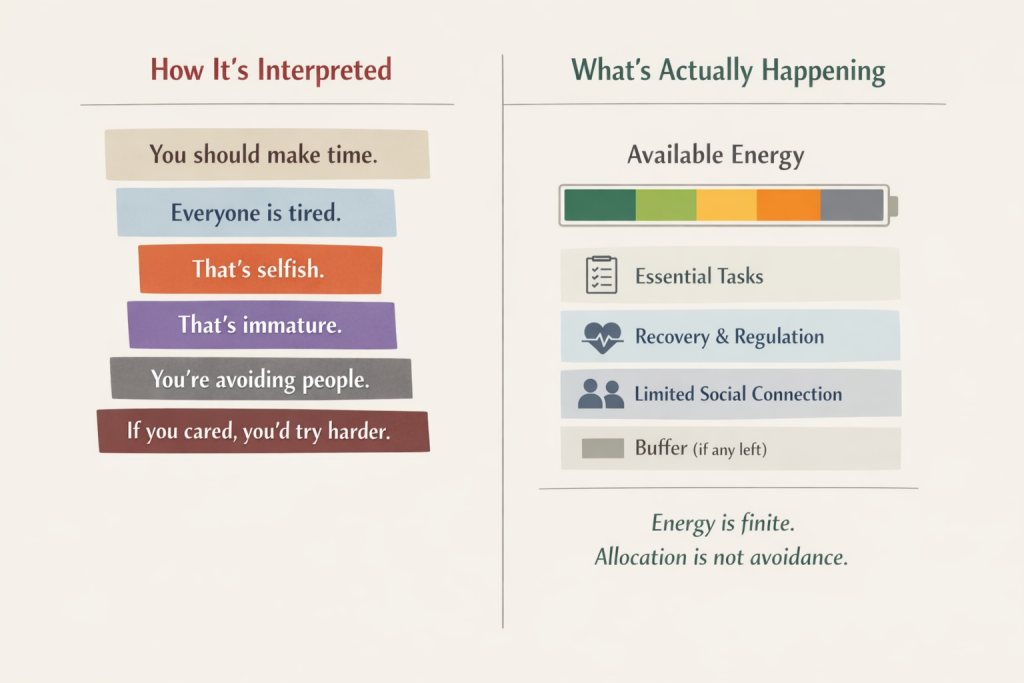
Even after autistic adults understand their energy limits, guilt often persists. That is because the guilt is not personal. It is neuronormative.
We are taught that:
Under these rules, allocating energy toward oneself feels like a failure, even when it is the only reason someone remains functional. The choice may be necessary, but it is not culturally legible as responsible or mature.
This is why reassurance alone does not work. The guilt is not about doubt or misunderstanding one’s needs. It is about violating an unspoken moral economy around time, effort, and relational access—one that treats availability as proof of care and self-limitation as a moral shortcoming.
Reframing matters, though not as a mindset exercise, but as an accuracy correction.
You are not avoiding people.
You are allocating energy.
You are not choosing yourself over others.
You are choosing sustainability over depletion.
You are not rejecting relationships. You are acknowledging that relationships do not exist outside bodies, and bodies have limits.
Self-advocacy, in this context, does not require enthusiasm, explanations, or permission. It requires honesty about capacity.
“I don’t have the energy for this” is not a value judgment. It is a physiological statement.
When families struggle with these boundaries, they are rarely reacting to absence alone. They are reacting to the loss of assumed access.
Accepting autistic energy limits often requires grieving:
That grief is real. But it does not belong to the autistic person to resolve by sacrificing their health or stability.
Choosing rest, solitude, or quiet pleasure is not immaturity. These are choices that reflect competent self-management in a system with known constraints.
Adulthood is not defined by how much you can override yourself. It is defined by how well you understand your limits and live within them.
Allocating energy toward regulation, recovery, and sustainability is not avoidance.
It is what makes participation possible at all.


"*" indicates required fields
"*" indicates required fields

