Authenticity is often described as a value. For many autistic people, it functions as something else entirely: a condition that allows interaction to be interpretable.
Autistic social processing relies heavily on stable mapping between signal and meaning. When another person communicates directly, follows through, and means what they say, the interaction becomes predictable. Prediction reduces cognitive load. Reduced cognitive load allows participation.
When signals contradict (e.g., words and actions diverge, expectations shift without explanation, emotional rules change mid-interaction) the relationship stops being a solvable system.
The difficulty in inauthentic relationships is therefore not about liking honesty more or disliking nuance. It is about sustained exposure to unresolved social prediction error. The autistic nervous system is not reacting to rudeness; it is reacting to an environment that cannot be reliably modeled.
Autistic individuals tend to build understanding through pattern detection. Social meaning is constructed by accumulating reliable correspondences: this tone means frustration, this phrase means reassurance, this behavior predicts this outcome.
In an inauthentic relationship, those correspondences fail.
Someone says “it’s fine” but later reacts as if it was not fine.
A boundary exists one day and disappears the next.
Feedback is indirect, then suddenly urgent.
The mind begins a continuous internal process:
What changed? Which signal is real? Did I misunderstand? What rule am I using now?
Anxiety increases not because the autistic person is overthinking, but because the environment has become under-specified. The interaction now requires constant inference rather than participation.
This mismatch often goes unnoticed because different neurotypes resolve uncertainty differently.
Many non-autistic people resolve ambiguity socially, through tone, contextual assumption, and dynamic negotiation. The relationship itself absorbs inconsistency.
Autistic people tend to resolve ambiguity analytically, by constructing a stable internal model that predicts outcomes. The relationship must therefore behave consistently enough to be modeled.
The same interaction can therefore feel flexible to one person and unstable to the other. One experiences nuance; the other experiences unsolvable variability.
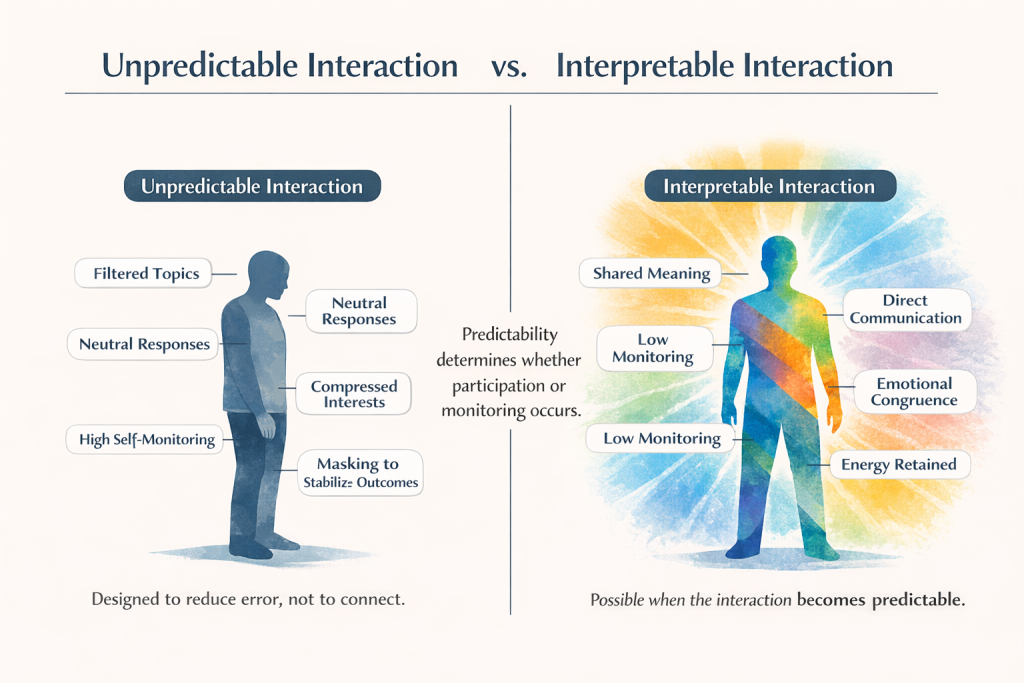
When signals cannot be trusted, participation shifts toward damage control.
Many autistic people respond by becoming agreeable, minimizing needs, or performing the version of themselves most likely to prevent negative reaction. Masking here is not social imitation for belonging; it is an attempt to reduce unpredictable outcomes.
Because direct communication no longer reliably produces clarity or repair, authenticity becomes risky. Over time, the person stops testing the environment and instead manages it.
The relationship remains intact, but participation is replaced with monitoring.
Another strain occurs in relationships expected to remain implicitly shallow.
Many autistic people are not confused about conversation itself; they are confused about where depth becomes unacceptable. Surface relationships often operate on unstated limits — logistics, mild humor, safe updates — enforced not by explanation but by subtle withdrawal or discomfort.
Without explicit boundaries, the autistic person must continuously infer an invisible threshold.
Topics that feel relationally appropriate internally may be received as “too much.”
The correction is rarely verbalized.
So calibration becomes constant.
To reduce error, many people begin making themselves smaller:
interests compressed
emotions muted
language simplified
experiences withheld
This is not adaptive flexibility. It is protective minimization. The goal shifts from connection to containment.
The relationship functions socially while becoming emotionally hollow.
When a relationship cannot be reliably interpreted, autistic people often become its stabilizing mechanism.
They anticipate reactions
smooth over inconsistencies
prevent escalation
manage emotional unpredictability
What appears externally as calmness is internally ongoing compensatory labor.
First they monitor.
Then they compensate.
Then they reduce themselves to lower error rates.
Withdrawal, in this context, is not disengagement. It is an attempt to make the interaction solvable.
Inconsistent behavior is often framed as a moral issue: fairness, honesty, integrity. But the distress arises earlier than morality.
Contradictions destabilize the internal model used to understand the relationship. Being asked to accept incompatible signals requires suppressing one’s own perception of reality, which erodes trust not only in the relationship but in one’s interpretation of events.
The problem is not disagreement. The problem is mutually incompatible rules of interpretation operating simultaneously.
When prediction error cannot be resolved, the nervous system treats the interaction as unsafe.
Hypervigilance increases
sensory tolerance decreases
attention narrows toward monitoring
The body shifts from social engagement to threat management because it cannot generate reliable expectation.
At this point, the relationship stops functioning as connection and starts functioning as a system to manage.
For many autistic people, authenticity is not an idealized relational virtue. It is the condition that makes social participation neurologically affordable.
They connect through shared truth, explicit meaning, and stable interpretation. Coherence allows safety.
When authenticity is missing, what remains is work:
interpretation
self-monitoring
compensation
emotional labor
Inauthentic relationships do not fail because autistic people cannot connect. They fail because the interaction never becomes predictable enough to inhabit.
When signals align and expectations stabilize, autistic relationships often show unusual depth, loyalty, and clarity. Not because autistic people demand perfection, but because coherence makes connection possible.
Authenticity, in this context, is not preference.
It is the condition under which the relationship becomes solvable.


"*" indicates required fields
"*" indicates required fields

