A client once said:
“I did exactly what they told me to do. I was honest. I was polite. I waited my turn. And somehow I was still the problem.”
She wasn’t reminiscing about snack time in elementary school. She was describing a recent staff meeting.
Many autistic adults share this experience. They grow up absorbing moral lessons that seem clear and absolute: Be kind. Tell the truth. Include everyone. Don’t argue. Don’t hurt people’s feelings. Share. Listen. Apologize. Compromise.
Those rules feel universal. They are like permanent coordinates for being good. But they were never universal. They were contextual: rules for supervised environments with predictable hierarchies, limited power, and benevolent oversight.
The problem arises when such guidance is carried into more complex adult systems without anyone announcing that the moral code has changed.
Most neurotypical children gradually internalize nuance by observing unspoken patterns: tone, group dynamics, exceptions allowed to certain people. By contrast, autistic cognition typically depends on explicit instruction. If a moral rule is framed as fact, it is stored as fact—unchanged until directly updated.
Adulthood quietly alters the formula:
“Be kind, but not at your own expense.”
“Be honest, but not socially costly.”
“Include people, but selectively.”
“Don’t interrupt... unless you want influence.”
The exceptions are rarely stated. The result isn’t a lack of intelligence or empathy. It’s a rule collision: two learned truths occupying the same moral space and both insisting on compliance.
Following the stated rule and still being criticized creates more than confusion. It creates instability in one’s moral framework. Over time, that instability manifests as:
The resulting distress is not about missing subtlety; it is about realizing that moral language is situational while having been taught to take it literally.
What once felt like integrity begins to feel like exposure.
Kindness without boundaries becomes depletion. Adulthood requires kindness balanced with protection of time, energy, safety, and priorities. Autistic adults often remain unwaveringly kind—at great personal cost.
Literal honesty is easy to uphold; calibrated honesty is not. Many adults soften, omit, or redirect truth for diplomacy. Those who speak plainly are labeled blunt, though their intention is clarity, not aggression.
Childhood equates hurt with wrongdoing. In adulthood, discomfort often accompanies truth. Avoiding all emotional impact leads to silence, self-suppression, and emotional over-responsibility.
As children, inclusion is morality. As adults, it is discernment. Selectivity becomes essential to sustainable connection. For autistic adults, declining often feels like betrayal of principle.
Respect once meant waiting to speak. In fast-paced adult exchanges, waiting too long can erase one’s voice entirely. Influence sometimes requires strategic interruption—a skill rarely taught.
This rule assumes a direct link between emotion and fault. Adults, however, react for countless reasons unrelated to intent. Habitual over-apology shifts responsibility away from fairness and toward appeasement.
Conflict aversion is rewarded in childhood but penalized in adult life, where negotiation and advocacy demand engagement. Avoidance often results in quiet disadvantage.
This assumes interpersonal symmetry. Autistic communication often prizes precision; neurotypical communication, modulation and implication. The mismatch generates tension despite mutual good faith.
These mismatched rule systems cause the most harm within hierarchies (workplaces, healthcare institutions, families governed by authority). Autistic adults often arrive rule-consistent, conscientious, and compliant. Yet in systems that reward strategic flexibility and punish literalism, consistency turns into vulnerability.
Ambiguity functions as a quiet currency of power. Those fluent in it navigate well in exceptions; those dependent on explicit instruction absorb the cost. The gap here is not social deficit but structural asymmetry: one group operating by discretion, the other by transparency.
The remedy is not performance coaching or social camouflage. It is explicit translation of moral scripts into adult frameworks:
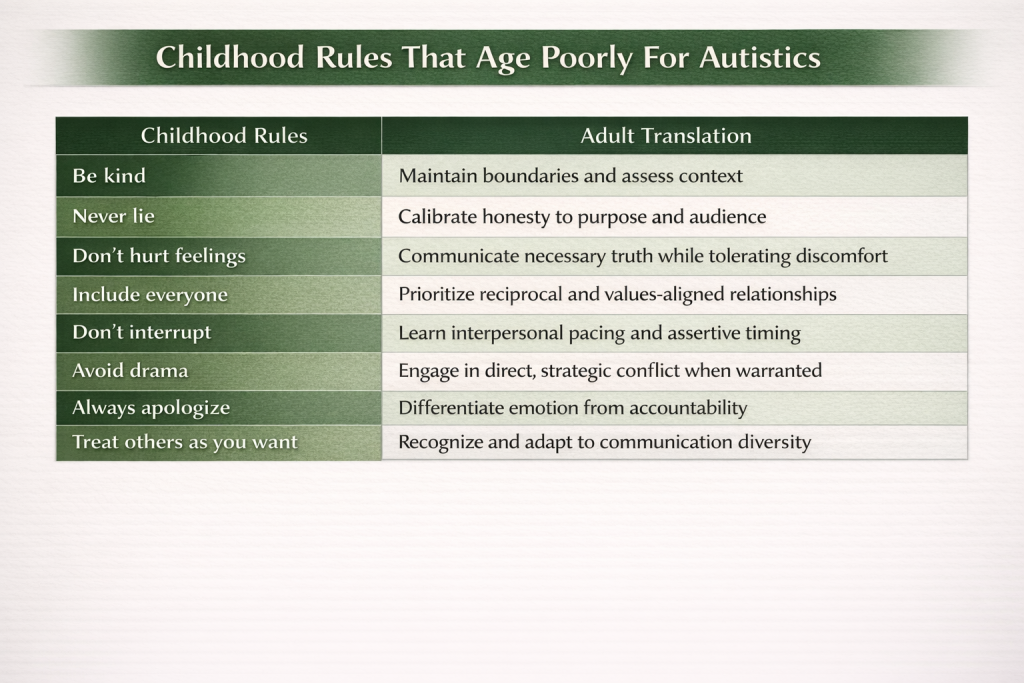
This is not behavioral training; it is teaching conditional logic: moral cause and effect with visible parameters.
Autistic adults do not fail at social integration; they operate faithfully within the rules they were taught. When society shifts the rules without notice and then penalizes adherence, integrity becomes misread as inflexibility.
Clarity is not rigidity. It is a moral stance. It represents trust in words, consistency in action, and belief in fairness as a stable principle.
If moral rules are conditional, they should be taught as conditional, not disguised as absolute and then revoked in adulthood. Believing what one was told should not be an error of judgment. It should be evidence of character.


"*" indicates required fields
"*" indicates required fields

