In conversations about autism, emotion often takes center stage—not because autistic people lack it, but because of how others read it. The way we label expression—flat, intense, inconsistent—reveals as much about us as about them.
Traditionally, some autistic people are described as having flat affect. More recently, clinicians have begun to recognize that some are highly expressive. Confusingly, the same person may be described as both, depending on the setting, the observer, or the moment.
Clinically and socially, this is often treated as inconsistency, or worse, as evidence that something doesn’t quite add up. But what if the problem isn’t the person? What if it’s how we’re interpreting affect in the first place?
Affect is often treated as a stable characteristic, something a person has. It is described in many static ways: Flat. Expressive. Blunted. Animated. Bright.
In truth, affect is dynamic. It shifts across contexts, relationships, and levels of demand. A person who seems “low affect” in a classroom might be vibrant with a trusted friend an hour later. What feels “overly expressive” in one setting may vanish completely in another.
It’s often labeled inconsistency.
More accurately, it’s regulation.
We like to imagine that affect directly mirrors inner emotion. But often, it acts more like an interface, a social control panel for managing how we’re read, interpreted, and responded to.
For many autistic people, that interface is learned rather than automatic. It’s observed, adjusted, and sometimes deliberately constructed.
So affect isn’t just expression. It’s also strategy.
What looks like “flat” or “low” affect can serve many different purposes:
From the outside, these can look identical. They’re not.
The reverse also happens. Some autistic people increase expressiveness—not because it comes easily, but because it helps them move through social space.
Again, the surface may look similar across people. Again, it isn’t.
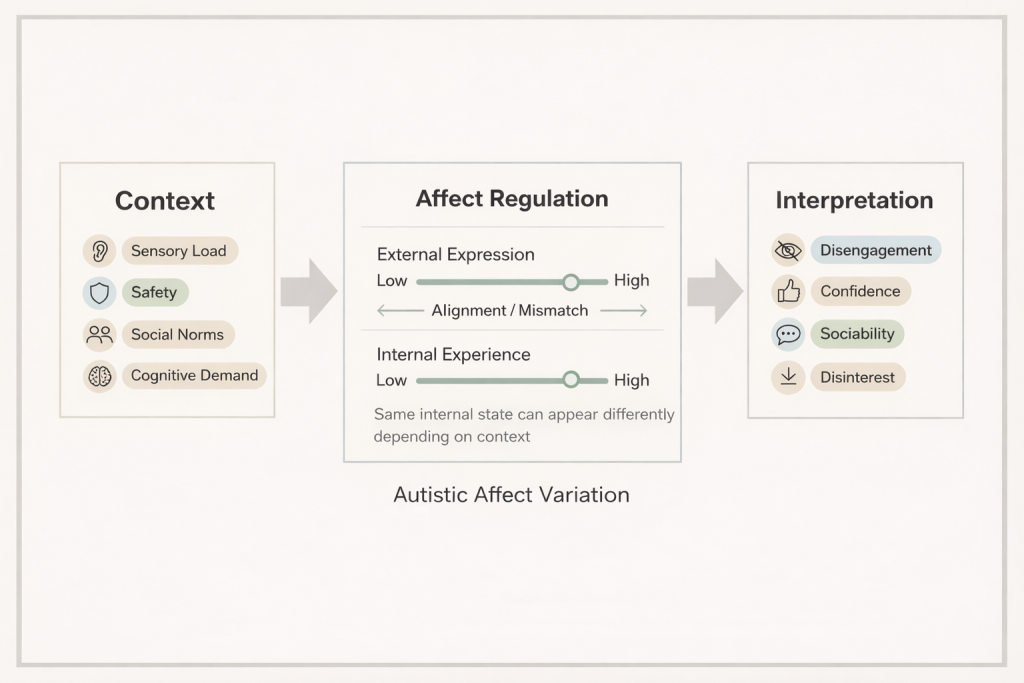
Two people can display minimal affect for entirely different reasons.
Two others might appear highly expressive for very different reasons.
And one person can shift between both patterns depending on context.
Imagine someone who stays quiet and still in a group meeting, yet later laughs freely with a friend.
Their emotional depth hasn’t changed; the safety of expression has.
When we treat affect as a direct reflection of personality or emotion, we collapse function into appearance. We assume meaning without asking what it actually does.
Reduced affect is often read as: disinterest, lack of empathy, disengagement.
Increased affect is often read as: sociability, ease, confidence.
These assumptions can be wrong in both directions. Effort gets mistaken for ease. Protection gets mistaken for absence. Strategy gets mistaken for personality.
And once those interpretations take hold, expectations shift—and with them, connection and understanding.
Instead of asking:
Why is this person flat? Or, why are they so dramatic?
Try asking:
What is this affect doing in this context?
What might it help manage, or avoid?
What does it make possible?
Because affect, especially in autistic people, is often less about revealing an internal state and more about navigating the external environment.
Affect isn’t a simple window into how someone feels. It’s part of how they move through a world that constantly measures expression.
Sometimes, what looks like absence or excess is actually precision—a calibrated response to what the situation requires, allows, or makes risky.
Not flat. Not exaggerated.
Strategic.
A language of adaptation, and, often, of survival.


"*" indicates required fields

