Most of us have been on the receiving end of someone else’s emotion:
Often, these emotional expressions are not paired with a direct request. The other person is not making an explicit demand. And yet, many people describe a familiar internal experience:
“I feel like I’m supposed to do something now.”
This reaction is frequently misunderstood. I often have clients report being told they are overreacting, misreading intent, or being too sensitive. But the issue is often not what was expressed. It is how emotional information is translated into obligation.
One helpful way to understand this difference is as a continuum, not a flaw or a binary trait.
On one end, another person’s emotion functions primarily as information:
On the other end, emotional expression functions as action-forcing:
Most people live somewhere in between, and may move along the continuum depending on the relationship, the emotion involved, and what is at stake.
There is no single “correct” way to respond to other people’s emotions. Where an emotion lands depends on nervous system sensitivity, relational history, and context. Rather than sorting reactions into right or wrong, it is often more useful to notice patterns.
The continuum below maps how emotional expression can move from information to pressure.
1. Information
“I notice the emotion. I still decide.”
The emotion registers as data. There is no urgency, no internal pressure, and no sense that a response is required.
2. Influence
“This matters, but it’s not decisive.”
The emotion has weight. There may be a pull to respond or reassure, but choice still feels intact.
3. Relational Pressure
“Not responding will create tension.”
The person anticipates discomfort, conflict, or disappointment. Saying no feels possible—but costly.
4. Moral Obligation
“Because they feel this way, I should act.”
Emotion now carries ethical meaning. Guilt, responsibility, or fear of being wrong emerge. The range of acceptable choices narrows.
5. Coercion
“I don’t really have a choice.”
Even without explicit demands, agency feels overridden. Action is driven by emotional pressure rather than consent.
These positions describe internal experience, not intent. No one needs to be manipulative for emotion to become binding.
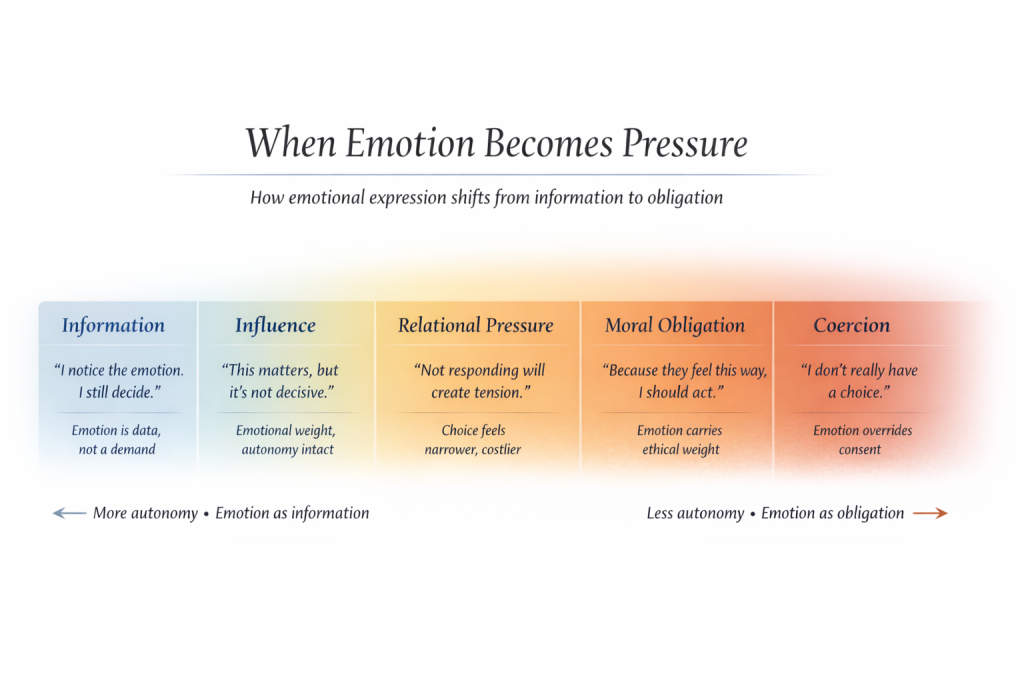
Most conflict and confusion happen in the middle of this ladder, where there is no overt pressure. The emotion may be understandable, even reasonable. And yet something may still feel off.
Because the pressure is internal and relational rather than explicit, people often:
Naming the middle helps people recognize what is happening before resentment, shutdown, or rupture occur.
Not all emotions exert pressure in the same way. Emotional expressions carry different implicit meanings—about risk, responsibility, safety, or relational stability. Those meanings shape whether an emotion is experienced as optional information or as something that requires action.
As a result, different emotions tend to move people along the continuum in different directions:
The common thread is whether the emotion is experienced as optional information or a demand for action.
High-stakes decisions are where the difference between emotion as information and emotion as obligation becomes most visible. When choices involve the body, identity, safety, or long-term consequences, emotional expression can shift very quickly from something to consider into something that feels action-forcing.
The examples below are not meant to establish right or wrong behavior. They are meant to illustrate how emotional expression can alter the internal experience of choice, even in the absence of explicit pressure.
Consider the experience of an adult client who felt pressured to take an SSRI. No direct demand was made. Instead, her mother expressed that the client’s OCD symptoms were deeply distressing and “triggering” for her. The mother’s emotional response was genuine. She felt overwhelmed by what she was witnessing and was struggling to regulate her own reaction.
For the client, however, that emotion did not land as background context. It landed as responsibility.
The internal translation was not simply, “My mother is having a hard time,” but, “I should change my body or brain state to relieve her distress.” In that moment, the decision no longer felt like a collaborative exploration of treatment options. It felt like a moral obligation to manage someone else’s emotional experience.
What made this especially potent was not the medication itself, but the stakes: bodily autonomy, identity, and the implicit message that relief for one person required compliance from another. The emotional expression functioned less as shared information and more as leverage—moving the client rapidly along the continuum from choice toward compliance.
A similar dynamic often appears outside of healthcare.
Consider an adult who is deciding whether to attend a family gathering. A parent expresses disappointment and sadness, sharing how much it would mean to them for everyone to be together. Again, no demand is made. The emotion is real and understandable.
But for the adult child, that sadness translates into obligation.
The decision is no longer simply about availability or capacity. It becomes about preventing hurt, avoiding guilt, or preserving the relationship. Saying no may still be technically possible, but it now carries a moral cost. The emotion narrows the range of acceptable choices.
As in the medical example, the pressure does not come from intent. It comes from the way emotional expression is internally experienced as something that must be resolved through compliance.
In both cases, emotion becomes action-forcing because:
Seeing these patterns clearly allows people to distinguish between caring about someone’s feelings and being required to change oneself to manage them.
That distinction is often the difference between choice and compliance.
Most people do not stay in one place on the continuum. They move—sometimes quickly—depending on context, relationship, and stakes. A person who experiences emotion as informational in one setting may experience it as pressuring in another.
Certain conditions reliably increase the likelihood that emotional expression will be experienced as action-forcing rather than optional. These factors do not cause pressure on their own, but they make movement toward obligation more likely.
Under these conditions, people are more likely to slide rightward on the continuum:
Under these conditions, emotion is more likely to feel action-forcing, even when no demand is stated.
Just as people can move toward obligation under certain conditions, they can also move back toward autonomy. This shift does not require becoming less empathetic or less connected. It often happens when the surrounding context makes room for choice again.
The factors below do not eliminate emotion. Instead, they reduce the likelihood that emotion will be experienced as action-forcing. They help emotional expression remain present without becoming binding.
Under these conditions, people are more likely to move leftward on the continuum, toward experiencing emotion as information rather than obligation:
These conditions allow emotion to be present without becoming binding.
If you are curious where you tend to land on this continuum, consider:
There are no right answers. The value is in noticing patterns.
Emotion does not need to disappear for autonomy to exist. But for some people, emotion needs to be handled carefully, with space, clarity, and reassurance that care does not require compliance.
If you have ever felt pressured without being pressured, that does not mean you are misreading intent. It may simply mean emotion crosses into obligation more easily for you.
Understanding where you fall on that continuum helps you care AND make room for choice.


"*" indicates required fields
"*" indicates required fields

