Many autistic clients describe their communication style as “neutral.” They mean this sincerely: clear information delivered without emotional intent, social maneuvering, or hidden meaning. The goal is accuracy. The function is regulation. The assumption is that if emotion and interpretation are removed, communication becomes objective and safe.
But autistic communication is not neutral. Believing it is neutral creates real consequences. What feels neutral from the inside is often read as intense, abrupt, or emotionally charged by others. Not because autistic people are communicating incorrectly, but because “neutral” means something different depending on whose communicative system is doing the interpreting.
Understanding this distinction matters. When autistic communication is misread as cold, forceful, or interpersonal in intent, autistic people are pressured to soften, explain, or mask in ways that undermine clarity and self-regulation. The problem is not autistic communication style; it is the false assumption that neutrality exists at all.
Autistic communication often feels neutral to the autistic speaker for several reasons.
It is anchored to internal regulation.
Autistic people frequently rely on precision, factual clarity, and directness to reduce uncertainty. Communication functions as a tool for stabilizing the internal environment, not for negotiating relational meaning.
It is stripped of the performance layer.
Neurotypical communication often includes gesture, implication, softening, prosody, and social signaling. Autistic communication removes much of this because it feels unnecessary—or actively overwhelming.
Intent is informational, not persuasive.
When the goal is to convey a fact, explain a process, or clarify an event, it genuinely feels as though the content alone should stand on its own.
For many autistic people, calling their communication “neutral” is not just an observation. It is a response to being misunderstood. I find that clients often reach for the word when others react strongly or emotionally to something that feels internally calm and factual. Describing communication as neutral becomes a way to defend against escalation and to make sense of a mismatch that feels unfair: I didn’t speak sharply—why does it suddenly feel like a conflict?
From the autistic perspective, these elements combine to create a strong sense of neutrality: no agendas, no hidden meanings, no emotional manipulation. But communication is never evaluated solely from the inside.
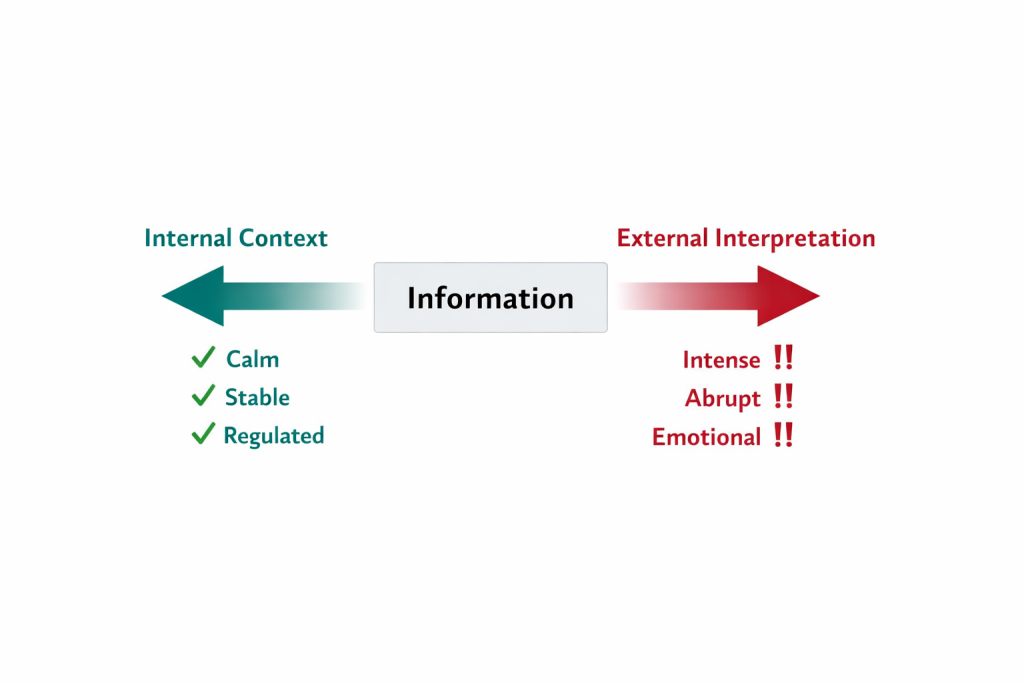
Even the most fact-driven communication carries context. Autistic communication is no exception—it simply carries different contextual markers.
Precision reads as intensity.
What feels stabilizing to the autistic speaker can feel forceful or urgent to the listener. Neutral factuality may be interpreted as emotional sharpness.
Directness reads as interpersonal meaning.
The absence of softening strategies often leads others to assign intention—critique, authority, or urgency—even when none exists.
Regulation strategies read as relational strategies.
When an autistic person increases detail or narrows focus to stay regulated, others may read this as controlling the conversation or redirecting the interaction.
Emotional neutrality is rarely actual emotional neutrality.
Autistic individuals often communicate while managing sensory load, social fatigue, or internal overwhelm. Voice, pacing, or facial expression may not match how neutral the speaker believes they are presenting.
In other words, a message that feels neutral when you send it may carry emotional, interpersonal, or contextual signals you did not intend.
For neurotypical communicators, “neutral” often means socially gentle, relationally quiet, soft in tone, low-impact, and easy to integrate.
For autistic communicators, “neutral” often means:
These are not equivalent. They may overlap in practice, but they function as different communicative languages with different rules for meaning.
When an autistic person believes their communication is fully neutral, they may unintentionally:
None of these outcomes reflect a communication deficit. They reflect a mismatch in contextual frameworks.
Autistic communication prioritizes internal logic, clarity, and accuracy over external relational expectations. That does not mean it lacks context—it means the context is internal rather than social.
Seen this way, everything shifts:
You are not “neutral.” Instead, you are consistent, context-stable, and predictable in your intention.
You communicate with informational integrity rather than interpersonal modulation.
This is a valid and effective communication style, as long as everyone understands the rules of the system.
The goal is not to change communication style. The goal is to build shared understanding of what your communication actually represents.
Some practical strategies include:
Autistic communication is not neutral, and it never has been. It is structured, regulated, and grounded in clarity rather than social performance. It carries internal context that is often invisible to others and misunderstood because it does not conform to dominant communication norms. Recognizing this frees autistic people from the impossible task of trying to sound “neutral” and instead allows them to communicate in ways that are consistent, self-stabilizing, and authentic—without apologizing for clarity.


"*" indicates required fields
"*" indicates required fields

